Writers in the Storm

A blog about writing

storm moving across a field
Interiority vs. Visceral Reactions in Deep POV

By Susan Watts

In my previous article, I explored how interiority allows readers to experience emotion from inside the character rather than simply observing it from the outside. That realization changed the way I approached deep POV, but it also led me to another important craft question:

If interiority creates emotional immersion, where do visceral reactions fit?

Early in my career, I learned one of the most important lessons in craft:

Don’t tell readers what a character feels. Show it.

I stopped relying on emotional labels and began replacing them with physical reactions. A character’s breath caught. Their pulse spiked. Their hands trembled.

And honestly, my writing usually improved right away. The scenes felt more active. Emotion moved through the body instead of sitting on the page as explanation. Readers could feel tension arriving in real time.

But eventually I noticed something frustrating. Even after adding strong physical reactions, some emotional scenes still felt strangely flat. Readers understood the emotion, yet they were not fully experiencing it alongside the character.

That was when I began to realize that visceral reactions and interiority are not doing the same job in fiction.

And understanding the difference changed the way I approached emotional depth in deep POV.

What Are Visceral Reactions in Fiction?

Visceral reactions are the body’s immediate, involuntary responses to emotion.

The word visceral originally referred to the body’s internal organs, which helps explain why these reactions feel physical before they feel intellectual. The body reacts before the conscious mind fully understands what is happening.

For example:

Her stomach dropped when she saw his name on the screen.

Readers immediately recognize emotional impact before the character consciously interprets the moment.

This is what makes visceral reactions so effective in fiction. They mirror nervous-system responses readers recognize from their own lives. A tightening throat or sudden rush of heat communicates emotional change quickly and naturally.

In deep POV, physical reactions create immediacy. However, immediacy alone does not automatically create emotional depth.

Why Physical Reactions Alone Can Still Feel Flat

A scene can contain strong body language and still feel emotionally distant.

For example:

Her chest tightened. She stepped backward. Her hands shook.

The emotional shift is clear and immediate. Readers sense tension before they consciously define it. That speed matters because it keeps scenes emotionally active. Reactions create movement on the page and help readers feel the impact of a moment as it unfolds.

What remains unclear is why this particular moment matters to her personally. We can see the reaction, but we do not yet understand the emotional stakes beneath it.

The scene communicates emotion, but not yet emotional context. And context is often what creates depth. This is where interiority comes into play.

Interiority vs. Visceral Reactions: The Difference Writers Need to Know

The easiest way to understand the distinction between the two is to think about function.

Visceral reactions show how the body responds.

Interiority reveals how the character interprets that response.

In real life, emotions often work this way too. We react physically before we fully understand why the moment affects us so strongly.

For example:

Visceral reaction only

His grip tightened on the knife.

The emotion is visible.

Visceral reaction plus interiority

His grip tightened on the knife. If he loosened it even slightly, his hands might start shaking.

Now the fear gains personal context.

The reaction itself has not changed much, but the interior thought allows readers to experience the emotions beneath it. Deep POV becomes immersive when both layers work together. Physical reactions create immediacy, while interiority gives those reactions emotional significance.

Without visceral reactions, scenes can feel detached.

Without interiority, scenes can feel emotionally thin even when strong body language is present.

Why Bigger Emotional Reactions Don’t Always Feel Stronger

When emotional scenes feel weak, many writers instinctively increase intensity. They amplify fear, add stronger physical reactions, or layer in more visible distress.

I did this myself for years. I assumed stronger emotion meant louder emotion, when often the real issue was lack of personal context.

Compare these examples:

He froze in fear.

Versus:

He froze. The last time someone knocked on his door this late, his father never came home.

The second example carries emotional weight because it feels tied to a real-life experience. The reaction belongs specifically to that character rather than functioning as a general expression of fear.

Interiority creates emotional depth because it reveals how the character privately experiences the moment. That emotional layer may come from fear, expectation, identity, insecurity, memory, hope, or private associations unique to the character.

How Memory Deepens Interiority in Deep POV

One of the fastest ways to deepen emotional reactions is to allow the past to briefly enter the present moment.

This does not require a long flashback. Often a small emotional association is enough.

A hospital hallway may remind a character of devastating news, while the sound of boots in a corridor might pull someone back to childhood before they consciously understand why they reacted at all.

These brief associations reveal how the character experiences reality instead of simply describing external events. That is one reason memory plays such an important role in deep POV.

Interiority Does Not Always Come from Memory

Writers sometimes associate interiority primarily with backstory, but interiority is really about interpretation.

A character does not need to revisit the past for readers to experience emotional depth. Sometimes interiority emerges through anticipation. A character glances repeatedly at the clock because they already fear what lateness might mean.

Other times it appears through insecurity, contradiction, or avoidance.

A smile crossed his face, though part of him immediately searched for the criticism hiding underneath the compliment.

Or:

He checked his phone again, careful not to think about why silence from her felt different tonight.

In both examples, the emotional depth comes from private interpretation rather than visible reaction alone.

Memory is powerful because it connects present emotion to personal history, but deep POV becomes immersive whenever readers understand how the character internally experiences the moment unfolding around them.

How Emotional Immersion Works in Deep POV

The strongest emotional scenes rarely rely on body language alone. Readers experience emotions most deeply when physical response and personal interpretation work together on the page.

To help diagnose missing emotional depth in your writing, consider asking:

What does this moment mean specifically to this character?

One of the biggest shifts in my own writing happened when I stopped asking whether emotion was visible and started asking whether the emotion felt personal to the character experiencing it. That change altered the way I approached deep POV entirely. I became less interested in amplifying reactions and more interested in understanding what made those reactions matter to that specific character.

Readers connect most deeply when emotion feels personal rather than performed. And that is often where emotional immersion truly begins.

A Question for You

As you revise emotional scenes in your current manuscript, are your characters simply reacting, or are readers experiencing why those reactions matter specifically to them?

Because that difference is often where emotional depth becomes unforgettable.

About Susan

Under the pen name Michelle Allums, Susan Watts has authored a young adult urban fantasy titled, The Jade Amulet and is currently writing the sequel. Her short stories are also included in the anthologies Christmas Roses and Forever and Always.

Susan has dedicated over four decades to training in multiple martial arts styles and holds the impressive title of a five-time US Karate Alliance world black belt fighting grand champion. Through her karate school, she is able to impart martial arts and life skills. Susan also incorporates her martial arts knowledge into her writing.

An avid triathlete, she keeps in shape by running, biking, and swimming. She lives in the country with her husband, where they raise animals and enjoy being outdoors. Susan also has three grown children and numerous grandchildren. In addition, she is a CPA and VP of finance for a company in her hometown. 

You can connect with Susan on social media or her website.
Read More
Charting Your Course #3: Self-Publish Online (Part 2)

By Gale Leach

This article follows three earlier posts published on the Writers in the Storm blog:

Charting Your Course: How should you publish?
Charting Your Course #2: Self-Publishing in 2025
Charting Your Course #3: Self-Publishing Online (Part 1) [add hyperlink]

These posts explore the pros and cons of self-publishing, examine today’s self-publishing landscape, and conclude with the practical steps for self-publishing your book.

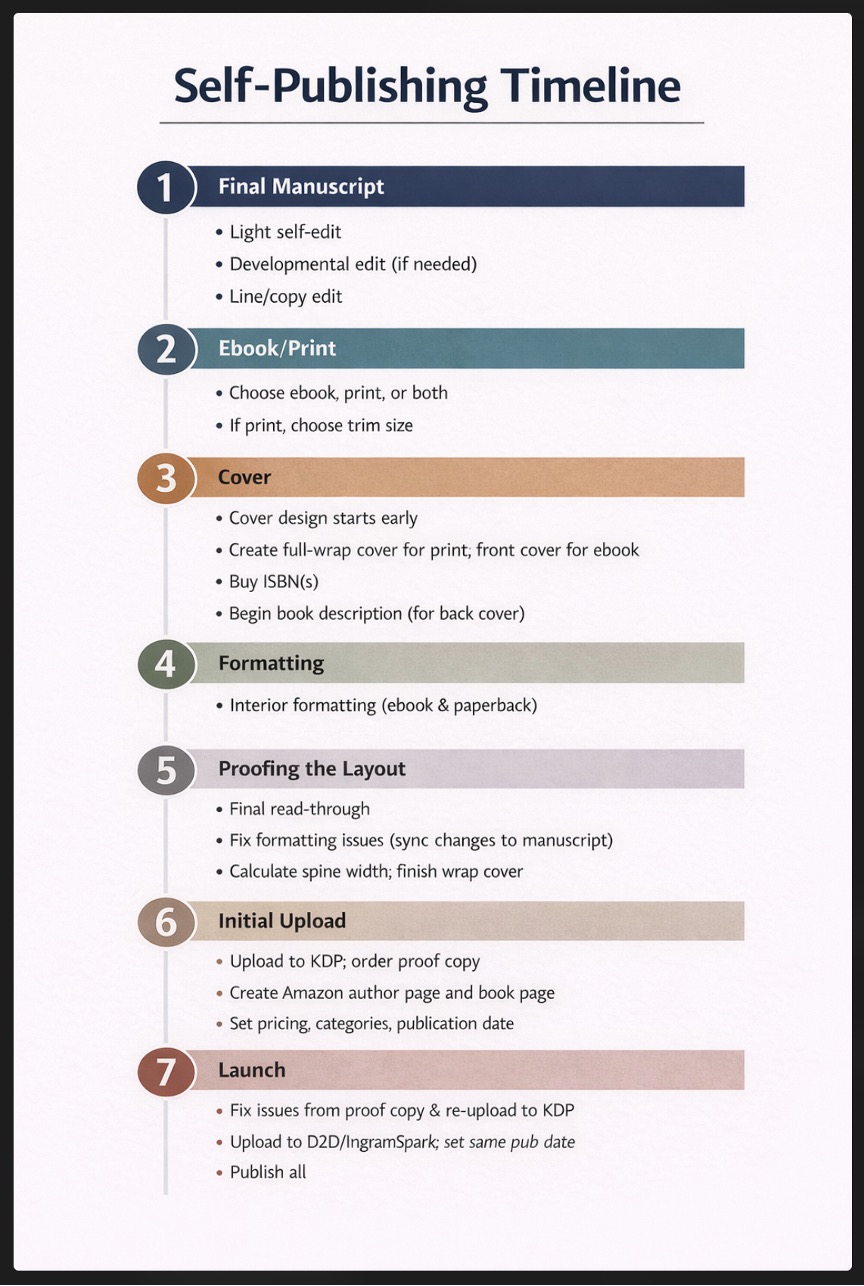
To remind you where we left off, the last post took us through 1) finishing the manuscript, 2) deciding whether to create an ebook, print book, or both, along with choosing a trim size, and 3) designing the cover. Now we begin with 4) Interior Design. Correlate the information shown in Fitzpatrick's article with my timeline (below) and the numbered steps that follow. https://www.usefulbooks.com/learn/self-publishing-checklist

4. Interior Design—Ebooks

Interior design is the process of attractively arranging text and images, if any, on a page in order to create a pleasant reading experience. The cover attracts buyers; the interior design keeps them reading through consistency, readability, good use of white space, and a visual style that matches the genre.

For an Ebook

 If your book is mostly text, an ebook should be simple to format and lay out. The goal with ebooks is to keep things simple. They must look good on so many different devices—that means you should not format your text in elaborate ways. Look at other ebooks you like and emulate what they do. If your ebook has many graphics, it would be wise to find help.

Most platforms accept Word documents and can convert them automatically to EPUB, the standard ebook format. (MOBI, the older Kindle format, has largely been phased out in favor of EPUB, and PDF is not recommended.)

If you have images or designs, you will still need to work on the layout, which can be complicated. I suggest getting help with this.

Ensure your file is clean: consistent chapter headings, proper scene breaks, no manual tabs or extra spaces, and a linked table of contents where appropriate. Keep your ebook file neutral; nothing fancy. Fitzpatrick writes more about this in his Section 3.1.

After upload, ebooks typically appear on Amazon within 24–72 hours.

Ebook Pricing Strategy

Typical debut pricing ranges:

Ebook novel: $2.99 – $4.99
Ebook nonfiction: $5.99 – $9.99

For a Print Book

Print book interior design includes:

  • Trim Size: The book’s height and width. The most common trim sizes for standard trade fiction and nonfiction books are 5″ x 8″, 5.5″ x 8.5″, and 6″ x 9″, with 6″ x 9″ being the standard for mass market fiction (e.g., novels) and nonfiction in the United States. You will need to decide which trim size you want before sending the book to a designer or printer or forging ahead with more tasks. The trim size you choose directly affects the page count of your book, and the page count determines the spine width. A 5″ x 8″ book coming in at 400 pages would only be 298 pages when set at 6″ x 9″.
  • Binding: The most common types of binding are hardcover, paperback, and spiral or coil. More people are buying hardcovers now, partly because of #BookTok and the aesthetic appeal of beautiful books on their shelves. The best binding for your book will be determined by page count, price (hardcovers are more expensive to produce than paperback), and trim size. I had a client who wanted to print a cookbook and we chose a spiral binding so it could lie flat, but those are rare. Not all bindings are available for all trim sizes. Before deciding on your binding or trim size, make sure KDP, D2D, IngramSpark, or your local printer can accommodate your needs.
  • Typography: Choose readable serif fonts (e.g., Garamond, Minion Pro, Palatino, Charter) for the body text, typically in 11 or 12-point size. I recommend not using decorative fonts unless they are extremely easy to read. A decorative letter at the start of a chapter is common, but refrain from much more than that.
  • Widows and Orphans: Avoid leaving single lines of a paragraph alone at the top or bottom of a page.
  • Too Much Text Per Page: Don’t cram content to save on printing costs because it makes the book hard to read.
  • Margins and Gutter: Leave sufficient white space, specifically a wider inner margin (known as the gutter—at least 0.75 inches to account for binding), usually with outer/top/bottom margins around 0.5 inches. If you make the inside margin too small, the text will disappear into the spine.
  • Chapter Openers: Many authors start new chapters roughly one-third to halfway down the page (sinkage). It’s also common to use stylized chapter numbers, headings, or drop caps.
  • Paragraph Alignment: You must choose between ragged-right or justified text.
    • Ragged-right has a consistent word spacing. Words are aligned on the left, with an uneven, "ragged" edge on the right. This is generally easier to read because of consistent spacing between words.
    • Justified text: Space is added between words to make every line the same width. This creates a clean, block-like look but can produce “rivers” of white space between words. It aligns both margins, creating a more professional appearance, but it requires careful formatting to avoid uneven spacing.
  • Running Headers/Footers: These are the page numbers and small lines of text that appear at the top and bottom of pages within the margin. Elements that might be included are the author name, book title, and/or chapter name for navigation. Typically these appear on most pages except chapter openers. Typically, I place the author name in the top margin of the left-facing (verso) page, with the chapter name in a running header at the top of the right-facing (recto) page.
  • Front and Back Matter: This consists of the title page, copyright page, table of contents, dedication, author bio, and other elements. An accepted standard exists for the order of these items. If you’re curious, see Kindlepreneur: Parts of a Book.
  • Bleed: Typically, this pertains to covers, where the image extends all the way to the edge of the printed page, but any graphic in your book can be set to bleed, and those must also be set to 0.125 inches beyond the trim line. Note: If you set one graphic to bleed in your interior file, all of your pages will need to be sized to include that 0.125 amount of space.

Prepare Print Book Files

Once your layout is complete, it's time to make the PDF you will upload to KDP.

Now that you have the ISBN, you can finalize your print book files in preparation for upload. The ISBN graphic goes in the bottom right corner of the back cover. The price of the book can be included in the ISBN (or not, if the price might change). Your imprint name can be listed on the back cover and included in the front matter on the copyright page. You list the book’s metadata on the form when you upload your print book or ebook.

Print Book Pricing Strategy

Typical debut pricing ranges:

Paperback novel (200-300 pages): $12.99 – $16.99

Paperback nonfiction (120-180 pages): $12.99 – $16.99
Paperback nonfiction (200-300 pages): $16.99 – $21.99
Paperback nonfiction (premium/academic/technical): $22.99 – $29.99

Royalties

I won’t go into the details of royalties here, as they’re well explained on KDP’s site, but here is one example for a 250-page 6×9 paperback:

Printing cost: about $4.50–$5.50
Retail price: $14.99
Royalty: roughly $4–$5 per copy

Items that factor into determining your royalty are the number of pages in the book, whether you’ve chosen a standard trim size, the weight and type of paper, etc.

5. Proof the Layout

Proofread the finished interior book file for errors in layout/design. Hopefully all other errors have been fixed. Use Kindle Previewer to check the ebook. If errors are found, synchronize fixes back to the original manuscript.

6. Initial Upload

Your finished upload should consist of two high-resolution PDFs (one for the cover and one for the interior with embedded fonts). You make these choices on the PDF creation screen.

I recommend you follow the progression below:

  1. Upload the ebook to Amazon KDP. Visit https://kdp.amazon.com and sign in (or create a new account). Amazon is the largest retailer of books in the world. You want your book there.
  2. Do NOT select expanded distribution. That will be handled through the following two uploads. Order and check through a proof of your print book. Ebooks can be proofed using electronic means.
  3. (Optional) Enroll in KDP Select for the first 90 days. This is a program requiring ebook exclusivity to Amazon in renewable 90-day periods. It offers access to Kindle Unlimited (KU) royalties, increased visibility, and promotional tools. Authors earn money based on pages read, can run free promotions or countdown deals, and may qualify for bonuses. After 90 days, you can unenroll and upload elsewhere. Disadvantages: Amazon earns between 30 and 65% of your sales; sample and author copies are subject to a charge; you may not upload to any other venues until 90 days elapses and you unenroll from the program.
  4. Upload to Draft2Digital. If you purchased your own ISBN, you can upload the same interior and cover file you sent to Amazon. If you used Amazon’s free ISBN, it belongs to Amazon, and you’ll need to get a new one from D2D or Bowker (the official ISBN agency for the United States). D2D will distribute the book (both ebook and print now) to many other retailers (check their website for a current list).
  5. Upload to IngramSpark. This is a subset of Ingram, the largest book distributor in the world. Bookstores, libraries, and schools order almost exclusively through Ingram. Uploading here provides easy access into their distribution system worldwide.

7. Launch

Before you click the “Publish” button at KDP or any other site, square away a few other things.

  1. Carefully check the proof copy. If you find errors, correct them in the file, re-upload, print a new proof, and keep that up until it’s correct. Each time you fix errors in the file, be sure to sync the changes with your initial manuscript as well (unless they are printer errors).
  2. Choose a publication date far enough in advance that you can send out advance review copies (ARCs), generate interest on social media and through your newsletter (something you should have been leading up to), and accrue presales. If you upload to more than just KDP, set your pub dates to be the same so your book will be available on all platforms at once.
  3. Prepare your launch and your publicity—then sit back and bask in the joy of being a published author!

Final Thoughts

Independent authors have access to global publishing tools that were once available only to major publishers. The hardest step is finishing the manuscript. Once that’s done, publishing becomes a series of manageable steps.

Knowledgeable professionals are available to help you get your book to market. Beware of fraudulent businesses that take your money and deliver little to nothing. Check Preditors and Editors (currently on Facebook while their website is rejuvenated) for help determining the goodness of a potential partner.

I have learned on my own how to do the steps outlined here and more when it was harder than it is today. I’ve watched others do so, too. Your previous computer experience will have a bearing on your comfort with the process, but it is something you can do, if you decide to do it. Also, people in your various writing groups can coach you through the sticky spots.

I wish you success! If you find this article helpful, please let me know. Good luck!

Reference:

Fitzpatrick, Rob. “The big self-publishing checklist.” Useful Books, March 4, 2025.
https://www.usefulbooks.com/learn/self-publishing-checklist

What part of the self-publishing process feels most overwhelming to you right now, and why?

About Gale

Gale

Writing The Art of Pickleball in 2005 launched Gale Leach’s career as an award-winning author. From 2011 to 2020, she also managed her own company, Two Cats Press, which published the works of six Arizona authors, including seven of her own fantasy adventure novels for children and teens. Currently, she’s at work on a fantasy trilogy involving magic, technology, multiple worlds, and creatures you only thought were mythological.

Gale and her hero husband live in Arizona, accompanied by two cats and a bearded dragon. Gale’s interests outside of writing include singing, playing music, genealogy, reading, crafting, and many types of puzzles and games. You can connect with Gale on social media or her website.

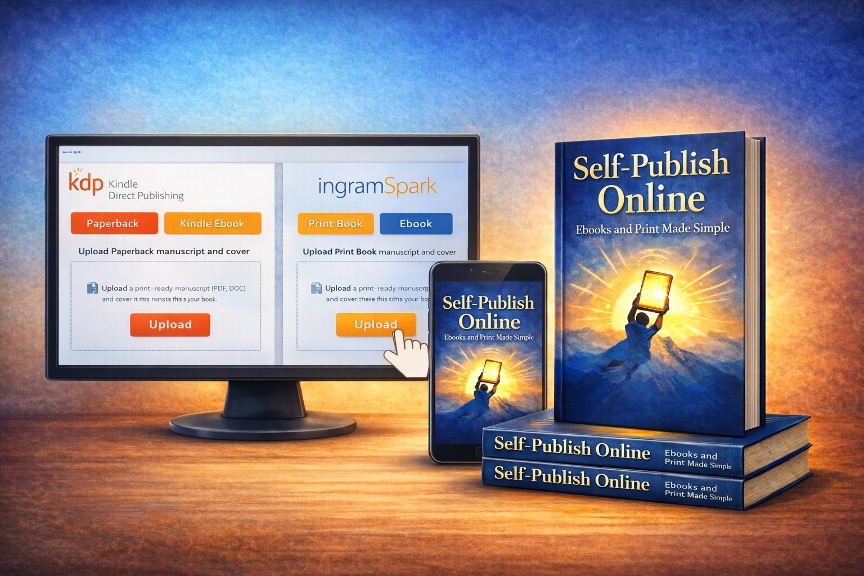
Header Image created by Gale Leach using ChatGPT

Read More
The Blueprint that Sells Books

By Penny C. Sansevieri

Many authors crave originality so fiercely that they mistake proven market structure for creative limits. That tension sits at the heart of why so many strong books underperform: readers make snap judgments, algorithms need clear signals, and covers, categories, and keywords must line up like runway lights guiding a plane.

A formula is not sameness; it’s scaffolding.

Think of it as the blueprint for building a house: plumbing, wiring, and foundation must follow code so the structure stands, but the interior is entirely yours. The market rewards “familiarity with a twist”—a recognizable promise delivered with your voice, your characters, and your unique angle. When that promise is muddled, decision fatigue rises, clicks stall, and discoverability dies on the vine.

Why Readers and Algorithms Need Clear Signals

Consumer behavior studies confirm what many authors feel but resist: familiarity reduces perceived risk. E-commerce eye tracking shows shoppers form impressions in a heartbeat, which is why cover design must signal genre instantly. If your thriller reads like a thriller but looks like a memoir, you’ve already lost most of your audience before they reach your description.

The same goes for categories and keywords. Amazon’s recommendation engine thrives on clarity, and roughly seven in ten purchases flow from algorithmic suggestions rather than direct name searches. That means your best bet is to mirror how readers already search for books like yours, not how you wish they searched for you. When your metadata aligns with reader intent, your book appears in the right places, at the right time, for the right people.

The Real Purpose of Tropes, Categories, and Metadata

Authors often push back from three angles: “my book is unique,” “I don’t want to be derivative,” and “I should invent my own path.” Each impulse is valid, but none requires rejecting structure. Trope frameworks in fiction—enemies to lovers, found family, locked-room mystery—aren’t cages; they are shared languages that help readers choose fast.

In nonfiction, the reader path matters just as much: are you solving a beginner problem or a scaling problem? Is your promise tactical or transformational? Your title, subtitle, and description should answer who it’s for and why they’ll care in the first lines. Lead with the hook, deliver the benefit, and echo the keywords shoppers use.

You’re not copying creativity; you’re copying clarity, which gives your creativity a fighting chance.

Signs Your Book Positioning Is Working Against You

Watch for red flags that you’re fighting the formula. If you claim your book fits multiple genres, you’ve diluted targeting and confused the algorithm. If reviews praise the writing but call the package confusing, you have a positioning issue, not a prose problem. If Amazon ads get clicks but no sales, the promise made by your ad doesn’t match the expectation set by your cover and page.

These issues are fixable without rewriting your manuscript: retune categories, sharpen keywords, refresh the cover to genre norms, and rewrite the first 150 words of your description to make the narrative promise explicit.

Most authors see traction when they align signals rather than add more tactics.

Protect Your Brand From Noise and Scams

Finally, protect your time and reputation. Scammers exploit busy creatives with fake outreach and Bitcoin requests. A legitimate team won’t pitch you from a throwaway email or promise guaranteed bestsellers and movie deals.

Channel your energy where it compounds: building recognizable signals, aligning with reader expectations, and delivering a unique twist inside a familiar frame. Master the structure, then decorate boldly. The market will reward the book it can understand in a second—and love for hours.

What’s harder for you as a writer: creating something original, or creating something readers instantly understand?

About Penny

Author photo of Penny Sansevieri

Penny C. Sansevieri, is a powerhouse in the publishing industry. As the Founder and CEO of Author Marketing Experts, Inc., she has revolutionized book marketing, shaping the careers of authors and guiding them to bestseller status. Penny's influence is undeniable—named one of New York Metropolitan Magazine's Top Influencers of 2019, she's known for her cutting-edge Amazon campaigns and innovative strategies that catapult exceptional books onto bestseller lists. She is also the author of 24 books and the co-host of the Book Marketing Tips and Author Success Podcast!

To learn more about Penny's books or her promotional services, visit www.amarketingexpert.com

Header image by Gavin Phillips on Unsplash

Read More
1 2 3 817

Subscribe to WITS

Recent Posts

Search

WITS Team

Categories

Archives

Copyright © 2026 Writers In The Storm - All Rights Reserved